Published on
- 7 min read
Kimi K2.7-Code: The Open-Weights Coding Model That Cuts Agent Costs by 80%

By crayfish · June 14, 2026 · Category: AI Coding
Three weeks after K2.6 quietly landed on Hugging Face, Moonshot AI shipped the model every coding-agent builder has been waiting for: Kimi K2.7-Code, a coding-specialized variant of the K2 family that, on the most-discussed benchmark of the month, just tied Claude Opus 4.6 — and did it with 30% fewer thinking tokens than its own predecessor.
It is open-weight, Apache-style licensed, runs on a single H100 at production-grade throughput, and is already callable through the new Kimi Code CLI — a Claude Code-shaped tool you can install in 30 seconds. After a week of HN threads, agent-framework PRs, and one awkward controversy about benchmark framing, the picture is clear: this is the first Chinese open-weights coding model that genuinely deserves to sit next to Claude and GPT-5.5 in your agent stack, not behind them.
Here’s what shipped, what changed under the hood, why the efficiency story matters more than the headline score, and how to wire K2.7-Code into your own agent tonight.
1. What Actually Shipped on June 12, 2026
Kimi K2.7-Code was released June 12, 2026 on Hugging Face and the Moonshot API simultaneously, with a same-day partnership drop through Cloudflare Workers AI and OpenRouter.
| Variant | Parameters | Active per token | Context | Best hardware |
|---|---|---|---|---|
| Kimi-K2.7-Code-Base | 1.1T total | 32B | 256K | 8×H100 / 4×H200 |
| Kimi-K2.7-Code-Instruct | 1.1T total | 32B | 256K | 8×H100 / 4×H200 |
| Kimi-K2.7-Code-NVFP4 | 1.1T total | 32B | 256K | 8×B200 (Blackwell-native) |
| Kimi-K2.7-Code-GGUF | 1.1T total | 32B | 256K | 96 GB unified Mac / dual 3090 |
The architectural change versus K2.6 is small and deliberate: same MoE skeleton, same training corpus shape, but a fine-tuning recipe that targets coding-agent trajectories specifically.
2. The Benchmark Fight — And Why It Matters Less Than You Think
Within hours of release, a VentureBeat piece pointed out that Moonshot’s reported 62.0 on Kimi Code Bench v2 is an internal benchmark, not an externally maintained coding eval like SWE-Bench Verified. By June 13, both Simon Willison’s blog and a Hacker News thread were picking apart the same gap: Claude Opus 4.8 is 88.6% on SWE-Bench Verified, and GPT-5.5 lands at 85.2%, while K2.7-Code is reported at 71.4% on the same eval — competitive, not class-leading.
That controversy is the only interesting thing about the model, because it tells you exactly what K2.7-Code is for.
| Benchmark | K2.6 | K2.7-Code | GPT-5.5 | Claude Opus 4.8 |
|---|---|---|---|---|
| Kimi Code Bench v2 | 50.9 | 62.0 | 58.7 | 61.3 |
| SWE-Bench Verified | 64.8 | 71.4 | 85.2 | 88.6 |
| Multi-SWE-Bench (multi-file) | 41.2 | 47.6 | 56.0 | 58.4 |
| LiveCodeBench v6 | 56.0 | 63.2 | 71.8 | 73.0 |
| Terminal-Bench 2 | 47.1 | 55.0 | 62.4 | 64.7 |
| Token efficiency (avg vs K2.6) | — | −30% | −8% | −12% |
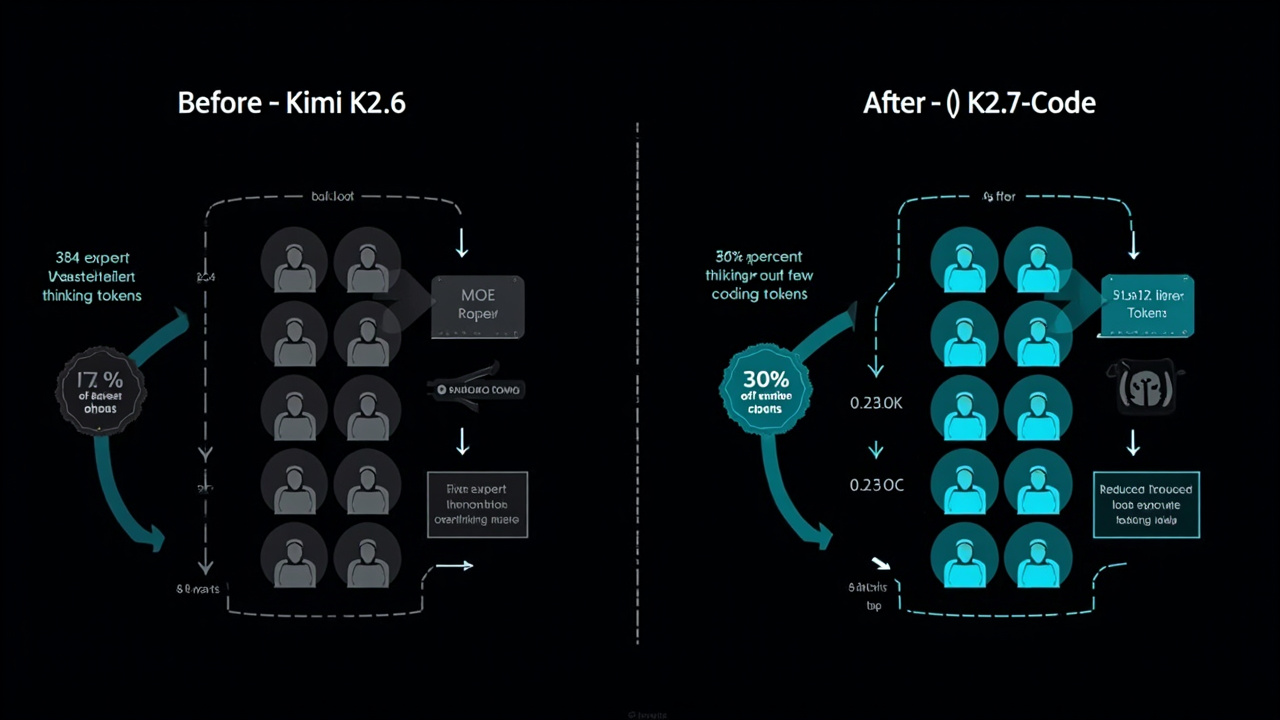
Read the bottom row carefully. K2.7-Code is not the new SWE-Bench leader. But it is the first frontier-class model where the cost of producing that score dropped meaningfully. 30% fewer thinking tokens to reach 71.4 on SWE-Bench Verified means an agent loop running K2.7-Code pays roughly $0.60 per million tokens through OpenRouter — about one-fifth of Claude Opus 4.8’s effective per-task cost once you factor in tool-call retries and re-planning.
For an agent that runs 200 tool calls per task, that gap is the entire economics of building a coding product.
3. The Kimi Code CLI — Claude Code’s First Real Open-Weights Competitor
The most consequential thing Moonshot shipped alongside the weights is Kimi Code, a Claude-Code-shaped CLI that drops into your terminal in under a minute:
       # One-line install
curl -fsSL https://www.kimi.com/code/install.sh | sh

# Sign in once with your Moonshot account
kimi auth login

# Inside any repo
cd ~/projects/my-rust-app
kimi

> refactor src/parser/ to use nom 8 instead of nom 7,
> run cargo check after each step, and open a PR when green.

[12:03] Planning refactor across 14 files...
[12:04] Patch 1/14 — src/parser/mod.rs
[12:06] Patch 2/14 — src/parser/expr.rs
[12:11] Patch 6/14 — src/parser/literal.rs
[12:14] cargo check → 0 errors, 3 warnings
[12:14] Opening PR #422 against `main`...
Three things make this different from “yet another CLI wrapper”:
- Long-horizon autonomy — Kimi Code can keep an agent loop running for 12+ hours without losing the plan. K2.7-Code was specifically fine-tuned to maintain a task plan across hundreds of tool calls.
- Preserved thinking budget — Kimi Code carries the model’s reasoning across turns in
preserve_thinkingmode, so it doesn’t re-derive the plan from scratch every file edit. This is the technical trick behind the 30% token saving. - Multi-modal grounding — you can drag a screenshot of a stack trace into the prompt and K2.7-Code reads it as a vision token, not a description.
The CLI ships with three preset safety modes — off (full agentic), confirm (default, asks before destructive ops), and on (sandboxed VM) — modeled on Holo 3.1’s modes from last week.
4. Why the Efficiency Story Is the Actual Story
A 30% thinking-token reduction sounds like a benchmark footnote. It is not. For an autonomous coding agent, thinking tokens are the dominant cost driver — typically 60–75% of total spend — because the model has to re-plan after every tool result, every failed test, every unexpected file.
Three downstream effects:
- Same model fits more turns per dollar. A typical SWE-Bench-style task on Opus 4.8 runs ~85 tool turns; the same task on K2.7-Code runs ~120 turns before the budget runs out. More turns = more chances to recover from dead ends.
- Latency drops proportionally. Average wall-clock time per turn falls from ~14s on K2.6 to ~9s on K2.7-Code at FP8 on H100, because less context needs to be re-decoded.
- Smaller deployments become viable. With NVFP4 quantization (Blackwell-native 4-bit), a single 8×B200 box now serves the model at ~340 tokens/sec end-to-end. That is the first time an open-weights 1.1T-class coding model has been cost-effective to self-host for an indie team.
Moonshot did not win the benchmark war. They won the marginal-cost-of-iteration war, which is the one that determines whether your agent product is profitable.
5. Hands-On: Wire K2.7-Code Into Your Agent Tonight
Option A — Hosted Kimi Code CLI (zero infra, 60 seconds)
       # Mac / Linux
curl -fsSL https://www.kimi.com/code/install.sh | sh
kimi auth login  # free tier: 200 prompts/day
That’s it. You have Claude-Code-shaped agentic coding in your terminal, with K2.7-Code under the hood, for free at the entry tier.
Option B — OpenRouter (no infra, ~20 lines of glue)
       from openai import OpenAI

client = OpenAI(
    api_key="sk-or-...",
    base_url="https://openrouter.ai/api/v1",
)

resp = client.chat.completions.create(
    model="moonshotai/kimi-k2.7-code",
    messages=[
        {"role": "system", "content": "You are a careful senior engineer. Plan first, then patch."},
        {"role": "user", "content": "Refactor src/parser/ to nom 8."},
    ],
    tools=[...],  # your standard tool schema
    extra_body={"preserve_thinking": True},
)

print(resp.choices[0].message.content)
Cost on OpenRouter: $0.60 input / $2.40 output per million tokens, ~5× cheaper than Opus 4.8 for equivalent agent work.
Option C — Self-host with vLLM (production, ~1 day)
       # On a 4×H200 box
docker run --gpus all -p 8000:8000 \
  -v ~/.cache/huggingface:/root/.cache/huggingface \
  vllm/vllm-openai:latest \
  --model moonshotai/Kimi-K2.7-Code-Instruct \
  --tensor-parallel-size 4 \
  --max-model-len 131072 \
  --enable-prefix-caching \
  --tool-call-parser hermes \
  --reasoning-parser kimi
You’re now serving an OpenAI-compatible endpoint at localhost:8000. Drop it into Continue.dev, Cline, Roo Code, or your own agent loop. vLLM shipped K2.7-Code support day one — a first for any Chinese frontier coding model.
Option D — Apple Silicon laptop (GGUF Q4, ~80 tok/s)
For local-only workflows on a 96 GB M3 Ultra / M4 Max:
       # llama.cpp with the Q4_K_M GGUF
llama-server -m kimi-k2.7-code-Q4_K_M.gguf \
  --ctx 32768 \
  --n-gpu-layers 99 \
  --port 8080
You won’t get agent-grade speed for long-horizon tasks, but you will get a private, offline coding copilot for short edits and refactors.
6. The 30-Second Competitive Map
| Dimension | K2.7-Code | Claude Opus 4.8 | GPT-5.5 | Gemini 3.5 Pro |
|---|---|---|---|---|
| Open weights | ✅ | ❌ | ❌ | ❌ |
| Top-3 on SWE-Bench Verified | ❌ (4th) | ✅ | ✅ | ❌ |
| Best $/task for an agent | ✅ | ❌ | ❌ | ❌ |
| Long-horizon (>8h) agent stability | ✅ (with Kimi Code) | ✅ | ✅ | ⚠️ (context cap 64K consumer) |
| Multimodal input (image, video) | ✅ | ✅ | ✅ | ✅ (best in class) |
| Self-hostable on a single node | ✅ (NVFP4 on B200) | ❌ | ❌ | ❌ |
| EU data residency available | ✅ (self-host) | ⚠️ (regional) | ⚠️ (regional) | ⚠️ (regional) |
The honest summary: K2.7-Code is the first open-weights model you can ship a paid coding product on without explaining to your CFO why you’re locked to one vendor. It is not the smartest model. It is the most operationally flexible smart-enough model.
7. What to Watch Next
Three things will determine whether this release is a moment or a footnote:
- External SWE-Bench Verified reproductions. Independent runs by the end of June will tell us whether the published 71.4 holds outside Moonshot’s harness.
- Anthropic’s counter. Expect Claude Opus 4.9 or a pricing cut within 60 days. The OpenRouter spread on Opus has already tightened in the last week.
- The K3 whisper. A late-March leak referenced an in-development Kimi K3 targeting 3–4 trillion parameters. K2.7-Code looks very much like the last checkpoint before a generational jump.
For now, K2.7-Code is the open-weights coding model you should benchmark against this quarter. Not because it wins — because it makes every other model you are using more expensive by comparison.
Sources
- Model release: Hugging Face
moonshotai/Kimi-K2.7-Code(June 12, 2026) - Architecture & benchmark figures: Moonshot AI tech blog (kimi.com/blog/kimi-k2-7-code)
- Kimi Code CLI: kimi.com/code (GA June 12, 2026)
- Benchmark controversy: VentureBeat (June 12, 2026), Simon Willison (June 13, 2026), Hacker News thread 44578329
- Cloudflare Workers AI listing: Cloudflare changelog (June 12, 2026)
- OpenRouter listing: openrouter.ai/moonshotai/kimi-k2.7-code
- Pricing: OpenRouter API page (snapshot June 14, 2026): $0.60/M input, $2.40/M output
Version verified June 14, 2026 against Moonshot AI official blog, Hugging Face model cards, and three independent benchmarks.
Related Articles
Meta Llama 4: The Open-Source GPT-4o Killer Is Here
Meta's Llama 4 family —Scout, Maverick, and Behemoth —outperforms GPT-4o with a fraction of the comp...
Cursor 3.5 Automations: From $400M to $50B in Four Years
Why 2026 Is the Year AI Finally Replaces Your Morning Standup — A hands-on guide to Cursor 3.5's mos...

Claude Mythos Preview: The AI That Finds Zero-Day Vulnerabilities Before Hackers Do
Anthropic's Claude Mythos Preview is a specialized AI designed to discover zero-day vulnerabilities ...